
I just finished updating my previous Christmas Time Again blog entry and pretty much exhausted the subject of which ESP chip to use – but I’m on a roll now.
It occurred to me that I have a living room cabinet with RGB WLED lights on the back (lighting up the wall in technicolour) and in the glass front I have white LED strip… so that’s two power supplies and controllers – one 5V supply for the WLED display at the back and a 12v supply and controller for the white displays in the glass fronted cabinet.
No arguing that the 5v WS2812 LED strips are more expensive than simple 12V white lead strip but then it occurred to me we’re moving soon, and I’ll be having to redo some of the lighting. Yes, of course the WS2812 strip is more expensive, but two power supplies and two controllers… I wondered, just as a thought experiment, what it would be like to use one lot of WS2812 strip and no controller, just the Wemos D1, and a high power 5V supply, splitting the lead strip into two segments. Well, it turns out that that is completely practical.
I have to say with a lot of help from Gemini-CLI (which for once got it right first time) I did the experiment with 5 metres of lead strip on my desk and my handy Wemos D1 board plugged into a 5v power supply. Now an additional complication is that I control all of this in Home Assistant. It turns out that it is quite easy to split up a given length of lead strip into separate virtual segments and control them separately, including effects and brilliance exactly as if they were completely separate entities.
For testing purposes, I wanted just over a hundred LEDs to be running rainbow, and another hundred LEDs to be running just dark blue, just to test. That then raised the question of, “Okay, you’ve done that. You’ve split the leads down the middle. You make a preset. Can you make the preset which runs at power-up, keep the two halves of the lead strips, separate?” And the answer is yes.
In this case, I’m using a single output pin to split the lead strip into two segments. But if you use two output pins, one for each segment, as far as the end product is concerned, it makes no difference. They’re just two segments as it turns out.
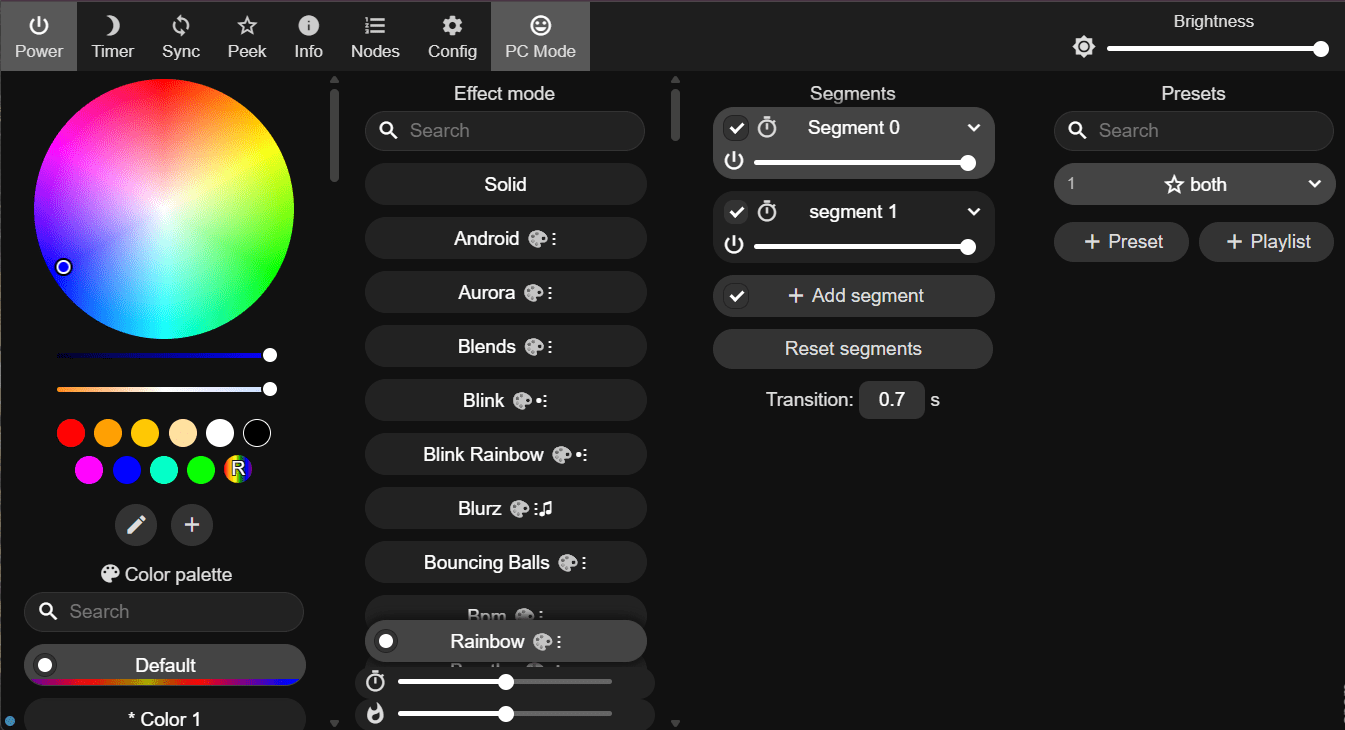
Note that at the image above, there is a brightness control on the top right. That is not how you would control the brightness of the two individual segments. Below the colour wheel on the left, there is a brightness control. So, I have the first half of my LEDs set as rainbow, the second half of my LEDs set as blue. That is in the second segment, which I called Segment 1. In there, you use the brightness control below the colour wheel to control its brilliance. When you save the preset, which I have called “both” And which is applied at boot, the separate brilliances will be maintained.
More on this when we move in the new year, multiple segmentss of WS2812 or similar strip is definitely the way to go.. maybe look at the 5v RGBWW strip though the white on my existing RGB strips is pretty good.